Modern luxury interior design has evolved. The focus is no longer on extravagance or elaborate decoration; instead, the most captivating spaces are now characterized by a core emphasis on materiality, intentional design, and restraint. Surfaces are selected not merely to cover a space, but for the powerful statement they make.
Fluted stone is more than a passing trend; it’s a sophisticated design philosophy. This technique takes natural material and transforms it into a dynamic composition, playing with light, shadow, and structure. It is where stone begins to move.
The Quiet Power of Texture
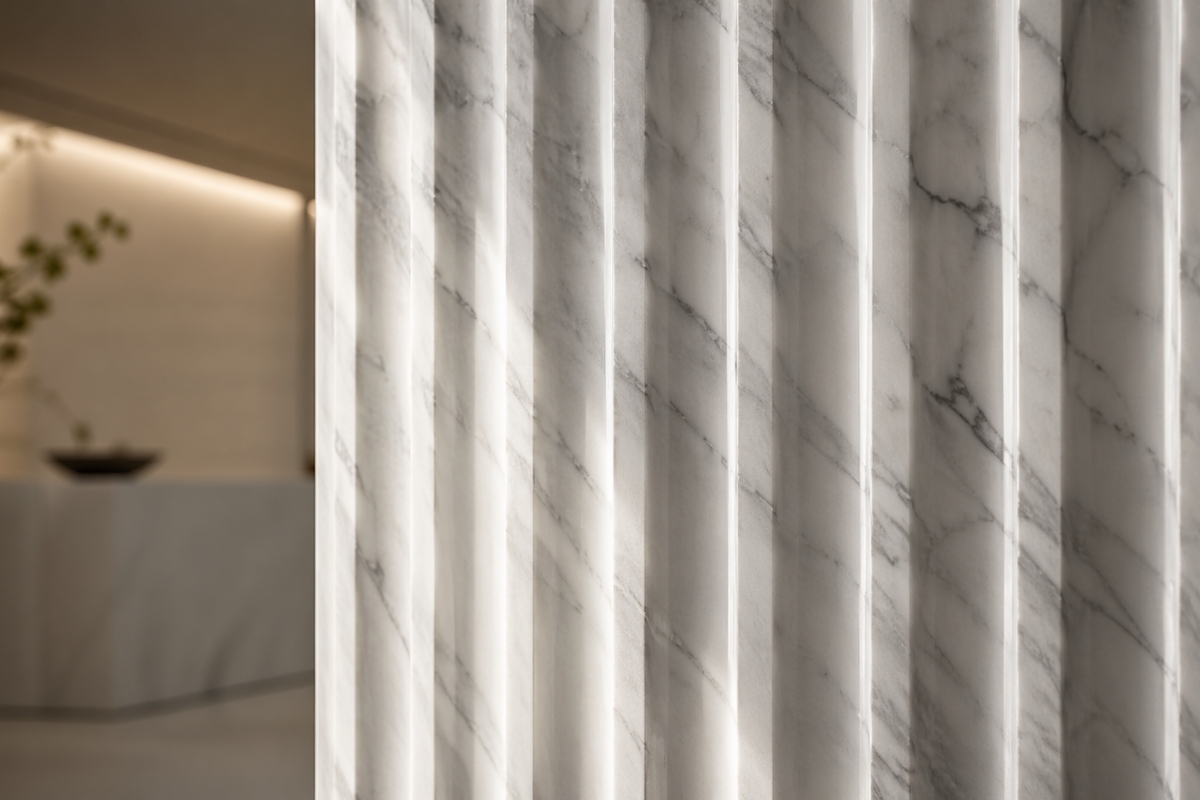
Fluted stone is characterized by rhythmic, precise grooves—concave or linear indentations carved to add depth to a flat area. However, its significance goes deeper than mere texture.It lies in how it interacts with light.
The stone’s texture is ever-changing, in perpetual motion as it reacts to the interplay of light and shadow. The grooves actively capture and release shadows, causing the surface to evolve continuously with the shifting daylight or the introduction of artificial light. This constant transformation, subtle at times and striking at others, showcases the stone’s innate ability to respond dynamically to its surroundings.
At One Stone, this quality is not incidental—it is intentional. Every fluted surface is envisioned as a living element within the space, designed to elevate not just aesthetics, but experience.
From Classical Origins to Contemporary Expression
The history of fluting is rooted in classical architecture, prominently featuring as the vertical grooves on Greek and Roman columns, where it represented permanence, precision, and proportion.Fluting, characterized by the vertical grooves seen on Greek and Roman columns, originates in classical architecture. These features historically symbolized permanence, precision, and proportion.
Today, that same principle has been reinterpreted for modern interiors.No longer confined to structural elements, fluting now extends across walls, furniture, and facades—adapted to suit minimalist environments that value clarity over complexity. The result is a seamless fusion of heritage craftsmanship and contemporary design sensibility.
Fluting, once limited to structural components, has now evolved, appearing on walls, furniture, and building exteriors. This adaptation caters to minimalist spaces that prioritize clarity over complexity. The outcome is a perfect blend of contemporary design sensibility and traditional craftsmanship.
It feels familiar, yet entirely new.
Sculpting Space, Not Just Surfaces
One of the most compelling aspects of fluted stone is its ability to reshape how space is perceived.
Luxury finishes that elevate the space:
- Vertical fluting introduces height, drawing the eye upward and creating a sense of architectural grandeur
- Horizontal fluting expands the visual width of a space, lending it calm and continuity
- Fine, shallow grooves offer understated elegance
- Deeper, wider patterns create bold, sculptural statements
Through these variations, stone becomes more than a material—it becomes a design instrument, capable of guiding movement, framing perspectives, and defining spatial rhythm.
A Material That Adapts Across Contexts
The versatility of fluted stone allows it to integrate effortlessly into a wide range of applications, each time bringing a distinct character:
Living Spaces
Feature walls crafted in fluted marble or quartzite introduce depth without overwhelming the room—serving as a quiet yet powerful focal point.
Kitchens
Sculptural elegance meets elevated functionality when fluted stone is used on islands or backsplashes, providing a tactile contrast to smooth countertop surfaces.
Bathrooms
Fluting brings a softening effect to smaller areas, establishing a spa-like ambiance where the emphasis is on texture rather than elaborate design.
Architectural Elements
Columns, partitions, and even facades benefit from the structured rhythm of fluting, transforming structural components into visual highlights.Fluting adds a structured rhythm to architectural elements such as columns, partitions, and facades, turning these functional components into compelling visual focal points.
At One Stone, each application is approached with a deep understanding of both material behavior and spatial intent, ensuring that every installation feels cohesive and considered.
Material Matters: Choosing the Right Stone
While the fluted finish defines the texture, the choice of stone defines the emotion.
-
Marble: Introduces softness and timeless luxury, with veining that enhances the flow of grooves.
- Quartzite: Offers strength and bold, dramatic patterns—ideal for high-impact spaces.
- Onyx: Brings translucency, allowing light to pass through and amplify the depth of fluting.
- Granite: Delivers durability and consistency, making it suitable for both interiors and exteriors.
The interplay between material and fluting creates surfaces that are not only visually striking, but also deeply individual—no two slabs, and no two spaces, are ever the same.
Craftsmanship Behind the Finish
Fluted stone is as much about precision engineering as it is about design.
Meticulous attention to detail and advanced processing techniques are essential for achieving a refined finish, uniform grooves, and maintaining the structural integrity of the material. The goal is a seamless result—where every curve is intentional and each line is perfectly aligned.
At One Stone, we guide this process through a commitment to quality, durability, and refinement. This ensures that every surface not only looks beautiful but also performs beautifully.
The Balance of Beauty and Function
While fluted stone is undeniably expressive, it also meets the practical demands of modern living:
- Durable enough for high-use areas
- Resistant to wear when treated and finished correctly
- Easy to maintain with proper care
- Suitable for both interior and exterior applications
This balance makes it a material that does not ask for compromise—it offers both longevity and luxury. As design philosophies continue to evolve, there is a clear movement toward intentionality—choosing fewer elements, but choosing them well.
Fluted stone embodies this shift.
It does not rely on embellishment. It does not compete for attention. Instead, it draws you in slowly—through texture, through light, through detail.
It rewards those who notice.
Beyond Trend: A Lasting Expression
Trends fade. Materials endure. Fluted stone is a design element that successfully bridges the gap between the contemporary and the timeless. Its application signifies a deeper value placed on authentic materials, expert craftsmanship, and the creation of spaces meant to be fully experienced rather than merely observed.The One That Stays
At its highest expression, fluted stone is not simply a design choice—it is a reflection of discernment.
A decision to move beyond the ordinary.
A commitment to detail.
A belief that true luxury lies not in abundance, but in precision.
At One Stone, every surface begins with this belief.
Because in the end, it is never about choosing many.
It is about choosing the one that stays.